
Why Your Departments Keep Clashing (It's Not a Process Problem)
Jun 24, 2026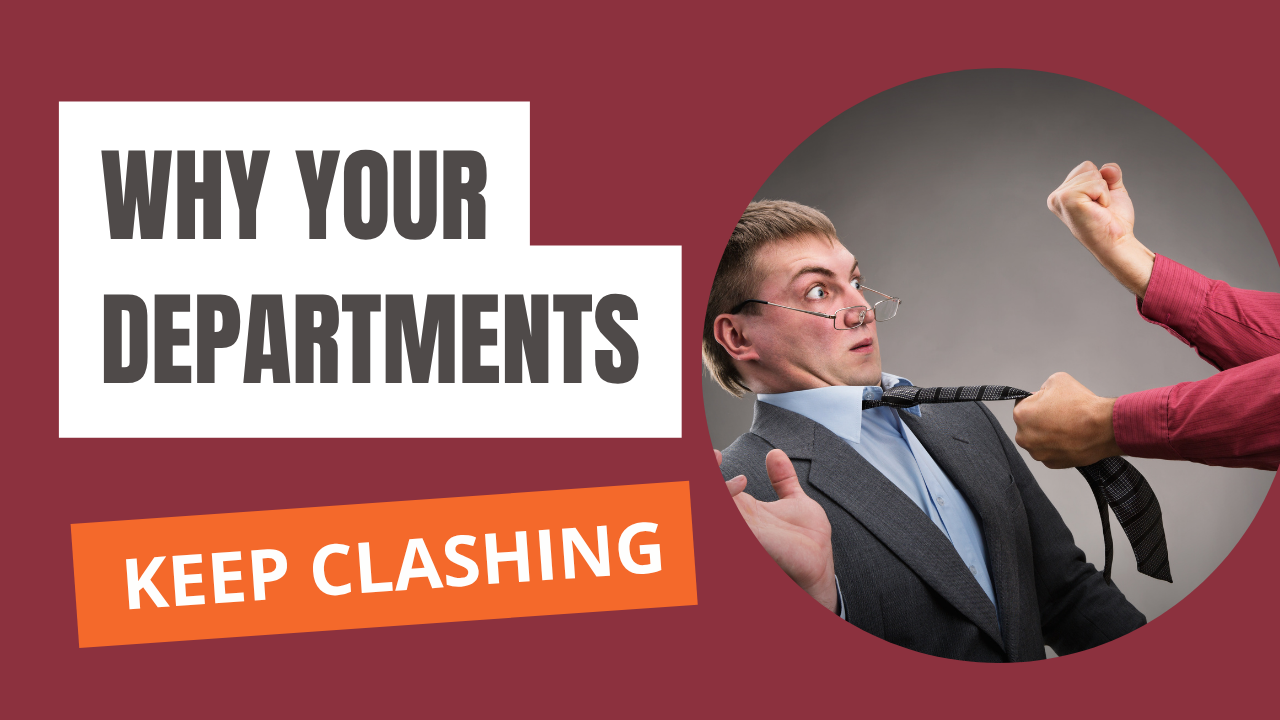
You've seen it. Finance and sales at loggerheads again. Operations frustrated with leadership. Middle management quietly absorbing tension from both directions. You tweak the process. You run a team-building day. Six months later, it's back.
Here's the thing: the clash isn't the problem. It's the symptom.
The real issue is that people don't understand each other.
Not on a surface level — most teams can describe their differences well enough. The problem is that understanding hasn't been installed at a deep enough level to actually change how people treat each other day-to-day. So when pressure goes up, judgment kicks in. And when judgment kicks in, you get gossip, finger-pointing, and the quiet kind of dysfunction that slows everything down and costs real money.
Let me give you a familiar example. Your sales team closes a deal — fast. That's their job; speed is how they're wired. Your finance team then needs time to verify, check, and set up the account properly — because accuracy and risk reduction are how they're wired. Neither group is wrong. But without a shared framework for understanding each other's operating logic, sales thinks finance is obstructing them, and finance thinks sales is reckless. Both retreat to their camps. And the new client sits in limbo.
Multiply that dynamic across every department, every hierarchy level, every change management project you've tried to roll out — and you start to see the real cost.
People are predictable. Difficulties with people are preventable.
That's not a platitude. It's the behavioural reality I've spent over 15 years applying inside organisations across 25 countries. When people don't understand why someone else operates differently to them, they default to the most human of responses: they assume the worst. They don't do it consciously. They do it because the brain fills gaps in understanding with judgment. It's the same mechanism that causes conflict at every scale — from a workplace disagreement to something far larger.
The fix isn't another framework pinned to the break room wall. It's an operating system — one that gives every person in the business, from the senior leadership team to the frontline, a shared language for human behaviour. Not as a one-off exercise. As something genuinely embedded.
This is where most organisations get it wrong.
They'll spend seven figures on a Salesforce implementation and then wonder why adoption is patchy. They'll run a DISC workshop, generate some interesting conversations, and move on to the next initiative. The light bulb moments happen — I see them regularly — but without depth and consistency, they fade. People revert. The friction returns.
What I've seen work — what actually shifts metrics — is when that operating system cascades from the top down and cuts across every department horizontally. When the person in IT understands why their sales counterpart is wired for speed. When the senior leader understands why the team below them isn't voicing concerns — and creates conditions where they can. When change gets designed around the people who have to live it, not just the people who commissioned it.
That's not soft. That's commercial. It shows up in production rates, claim reduction, sales growth, and staff retention. Every metric that either makes or costs your business money connects back to how well your people understand each other.
The clashes between your departments are giving you a signal. The question is whether you treat it as noise — or listen to it.
If this resonates and you'd like to explore what Communication Mastery could look like inside your organisation, I'd welcome a conversation. You can book a discovery call at calendly.com/bramlagrou/linkedin-consultation.
