
Difficult People vs People in Difficulty — What Leaders Need to Understand
Jul 01, 2026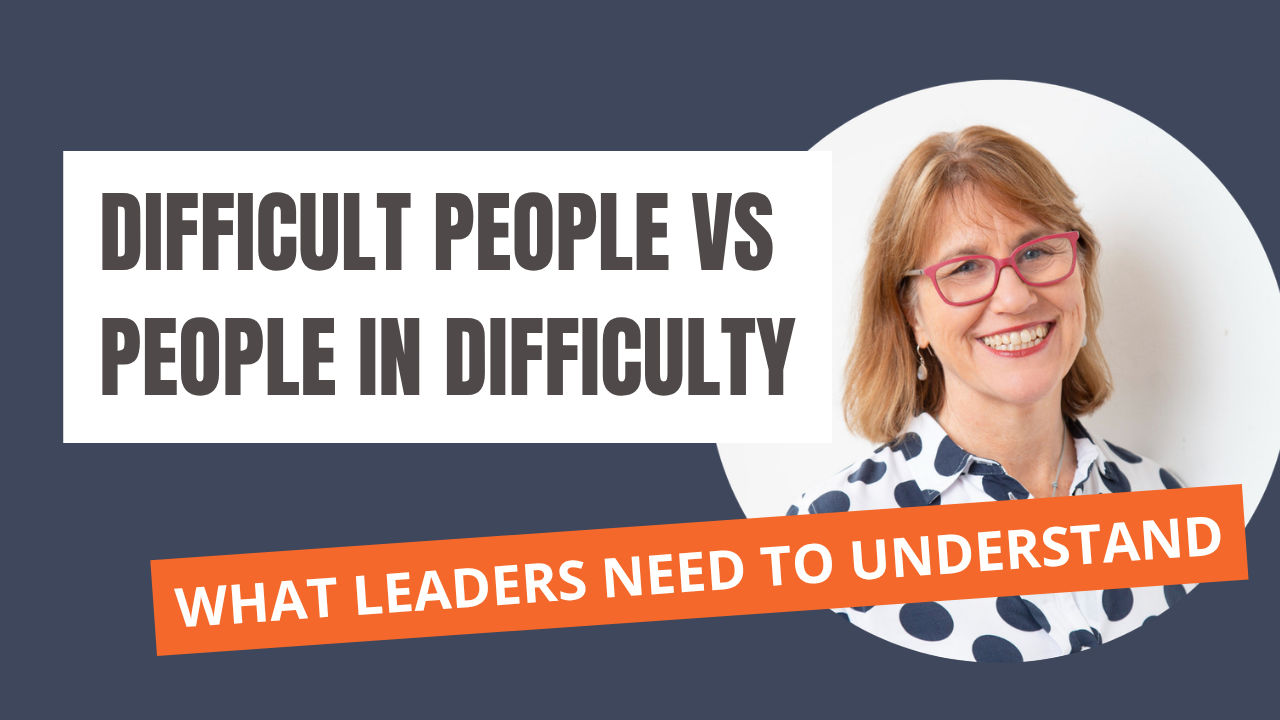
There's a label that gets applied fast in workplaces, and once it sticks, it's nearly impossible to shift.
Difficult person.
I sat down recently with Kate Russell — conflict resolution specialist, author of Leaders Who Lead, and someone who has spent over three decades walking into the most fractured teams imaginable — and she said something that I've been thinking about ever since.
"The moment you call someone a difficult person, you've closed the door. But if you walk in thinking, this is a person in difficulty — now you have empathy. Now you have curiosity. Now you have options."
It's a small shift in language. The commercial impact is anything but small.
Most leaders are dealing with the wrong problem
Kate told me about a pattern she sees constantly. A leader brings her in to mediate between two team members at each other's throats. She goes in, has a look around, and comes back with news the leader wasn't expecting: "You don't need a mediator. You need to look at how you're leading."
That's not an easy message to deliver. And it's not an easy one to receive. But here's what Kate has found time and again — the conflict between team members is usually a symptom. The root cause almost always traces back to the leader. Unclear expectations. Unspoken assumptions. Stress behaviours that the team are watching and responding to.
Two things can be true at once: good intentions and destructive impact.
Self-awareness is the job
One of the most useful things Kate said in our conversation came when I asked her what each DISC style most needs to develop as a leader. Her answers were sharp:
- A D leader needs to learn empathy
- An I leader needs to learn patience — slow down
- An S leader needs to learn courage — take the risk
- A C leader needs to learn curiosity — ask what you don't know
None of those are soft skills. They are the commercial skills. The ones that determine whether your team stays or leaves, performs or disengages, trusts you or tolerates you.
Psychological safety isn't the same as comfort
This is where Kate said something I think a lot of organisations get wrong. There's a tendency in the leadership development space to invest heavily in making people feel safe — and then wonder why performance hasn't shifted.
Safe does not mean comfortable. Safe means people can speak up, disagree, and challenge — and know they won't be punished for it. That's different from an environment where no one ever has a hard conversation.
If you don't have clarity on where you're going and what good looks like, all the connection in the world won't move the needle. Vision and accountability have to sit alongside the culture work. One without the other doesn't hold.
Connection is a commercial investment
Kate's phrase stuck with me: slow down to speed up. The leaders who skip the connection piece — who are too busy to check in, too pressured to ask how people are going — pay for it later. Usually at the worst possible time, when they need their team most, and find there's nothing in the bank.
People leave because they don't feel appreciated. Not because the work is too hard. Not because the pay isn't right. Because they didn't feel seen.
That's not a culture problem. That's a leadership problem. And it's a solvable one.
If your team's performance isn't where it needs to be, the conversation worth having is probably not the one you've been avoiding — it's the one you've been having about everyone else.
People are predictable. Difficulties with people are preventable. Communication Mastery is the way.
Want to understand how communication mastery translates into commercial performance for your organisation? Book a discovery call.
