
Your Buyer Isn't Indecisive. Their Brain Just Hasn't Caught Up Yet.
Aug 25, 2026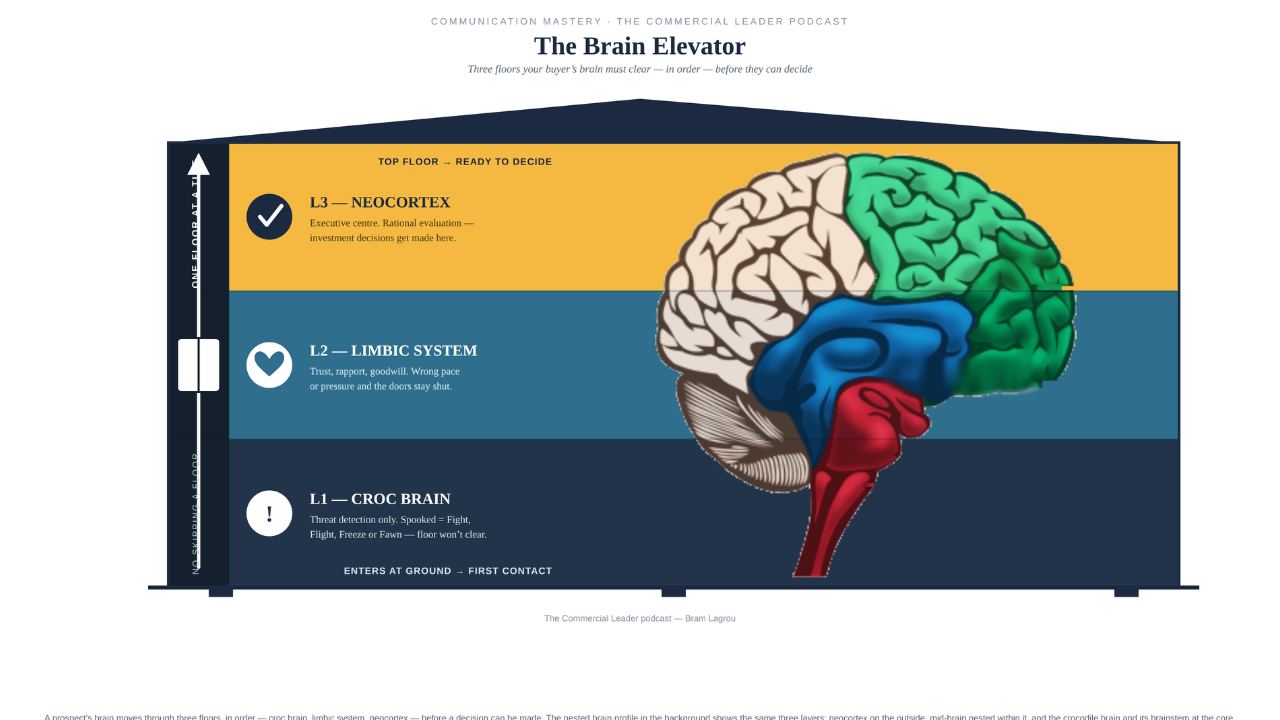
Think about the deal on your board that's been stuck in "late stage" the longest. Not the one you lost. That one's easy, you know what happened. I mean the one that's still technically alive. Every check-in gets you a "we're close" or a "just need to align internally," and it just doesn't move.
If you've gone looking for help with that, you're not alone. Buyer indecision is one of the most searched problems among sales leaders right now. And the advice you'll find is all the same: tighten your qualification, build more urgency, get a mutual action plan signed, ladder up to the economic buyer. All useful. None of it explains why a prospect who told you, in writing, that your solution is exactly what they need still can't bring themselves to sign.
Here's what I think is actually going on. Buyer indecision isn't a process problem. It's a psychology problem wearing a process costume.
The model I use with clients, and the one I want to leave you with, is something I call the "Brain Elevator". Picture your prospect's brain as a building with three floors, and your job, every single interaction, is to get them into that elevator and moving upward. You can't skip a floor. You can't talk your way to the top while the ground floor is still on alert.
Floor one is the crocodile brain. It isn't interested in your pricing or your value proposition. Its only job is threat detection. One pushy line, one whiff of "salesperson trying to close me," and it slams the doors shut. That's fight, flight, freeze or fawn. Fawn is the one that gets missed constantly: warm nodding, "this looks great," and then nothing happens. The way through isn't a better pitch. It's removing the perceived threat.
Floor two is the limbic system, where trust and goodwill get built or quietly torched. Get the pace wrong, or push before someone's emotionally ready, and the elevator doesn't crash. It just gets stuck here, indefinitely. This is most of your "they went quiet" deals. Not lost. Stuck.
Floor three is the neocortex. The rational, evaluating floor every sales process is actually built for. Here's the catch: none of your ROI calculators or comparison matrices work if the elevator never got there. A prospect whose crocodile brain or limbic system is still unsettled will nod at your brilliant logic and still not decide, because the logic never reached a floor that was open to receive it.
This is where stakeholder profiling earns its keep, because different people get stuck for different reasons and need a different key to open the doors. A high-D wants the bottom line, fast. A high-I needs the relationship built first. A high-C needs data and time, full stop. And a high-S — steady, conflict-averse, values being heard — is the profile that trips up the most salespeople, because it's easy to mistake their pace for indecision.
That's exactly what happened with Jan, a BDM I worked with, whose prospect had been stuck for close to two years. His champion was a textbook high S — smiling, nodding, warm, and never quite committing. That poker face wasn't hiding reluctance about the product. It was a people-pleasing instinct doing exactly what it's built to do: avoid friction, including the friction of a decision made before they felt ready. Jan, a fast-paced high I, was moving at a rhythm that felt completely normal to him and landed as pressure. We changed his expectations and his language. More space, less countdown, explicit patience. Within weeks, the deal that hadn't moved in eighteen months closed. Nothing about the product changed. The pace mismatch did.
If you've got deals on your board that sound like Jan's, that's exactly the kind of gap I help commercial teams close through Communication Mastery — building stakeholder profiling and the psychological read into how your reps actually run their deals.
Book a free discovery call here and we'll look at where it might be costing you.
